Showing posts with label Young Adult Fiction. Show all posts

Sunday, October 2, 2016

Queen of Wonderland or Average High School Student? - Y.A. Fiction

Title-  Unhinged

Author-  A. G. Howard   

Illustrator- (title page) -  Nathalia Suellen

Publisher- Harry N. Abrams

Copyright Date-  2014

Number of Pages- 416

Awards- None

Reading Level- Age 13-17

Genre- Young adult fiction, fantasy


Summary


This book follows Alyssa as she tries to maintain a life of a normal high school girl.   Her boyfriend Jeb is her high school sweetheart, and she is his girl next door.  They are living a normal life until one day Alyssa’s past comes back and almost kills her.  Alyssa is the future queen of Wonderland, and has spent time in Wonderland, but she thought that part of her life was behind her.  Then obsessed and dangerous toys start to terrorize her while she is at school, and people from Wonderland start to entire her life.  Morpheus enrolls in her high school, and starts to appear everywhere Alyssa goes.  As if that isn’t crazy enough Alyssa learns that her mother and father met in Wonderland, and that her mom rescued her dad from the evil Queen.  Just like Alyssa has to rescue her boyfriend Jeb from the same Queen.  With her “normal” world turned upside down Alyssa battles characters from Wonderland while trying to get ready for her high school prom.  What happens will remain a mystery until you read the book.  Will Alyssa stay, or will she return to Wonderland?


Teaching Ideas

This book could be used to teach perspectives.  Unhinged is loosely based off of, Alice's Adventures in Wonderland by Lewis Carroll.  In Carroll’s book Alice goes into Wonderland, in Howard's book the characters of Wonderland enter the real world.  Unhinged is about what happens to Alyssa, not Alice but they both are similar (yet very different) characters.  If the students read both books they could create their own story from the perspective of someone else from the books, such as the Red Queen, the Cheshire Cat, or the Mad Hatter.  The Queen appears in both books as does the Cheshire Cat, however they are very different characters in each of the stories.  The students could create a story in which a character from Carroll’s book meets a character from Howard’s book.  There are many opportunities to look at different perspectives and compare and contrast. 


Ratings

Element of Literature
Excellent

Average
Inadequate
Not Addressed


Rating
Plot
The plot is engaging; the reader is invested in the outcome.  Contains conflict, a climax and a resolution.    The reader buys into the story line; it is believable to the reader. 
The plot is average it contains some of the essential elements such as conflict, climax and resolution.  One element is either missing or poorly developed.  The reader may or may not buy into the storyline, it is just not that believable. 
Multiple essential elements, conflict, climax and/or resolution are missing or poorly developed.  It is not believable and overall a bad plot. 

The plot is engaging, yet it didn’t draw me in completely.  There were a few elements that were so farfetched that I didn’t buy into them, even for a world of fantasy.  The plot does contain conflict, an exciting climax and a partial resolution.  Because this is a series, the resolution wasn’t complete, you are left with a cliffhanger and need to read book three to find the full resolution.
Characters
Characters are unique and believable.  The characters come to life when the reader is engaged in the story.  When the book is done, the reader still connects with the characters of the book.  Characters have personalities, flaws, and feelings. There is a protagonist, possibly an antagonist and some supporting characters. 
Characters are similar to other books, have little to no uniqueness.  When the reader is done with the book, they are also done with the characters, there is no lasting connection.  Characters display little in terms of personality.  There are no supporting characters, or no clear protagonist.
Characters are dull and lifeless, there is no connection to the characters.  There is no clear protagonist and no supporting characters.  The characters are too farfetched.

The characters are based off of another book, however each character has his or her own unique personality in this book.  Although the characters do have strong and real personalities I did not connect to them. I don’t care what happens to them in the next book.  The protagonist is clearly Alyssa, and she has a few antagonists, mainly Morpheus.  The cast of supporting characters is long and well developed. 
Illustrations
The illustrations share in the story telling. The pictures help to develop the characters, establish the mood, and setting.  They contain some of the following elements, hidden details, facial expressions, different viewpoints, interesting asides, action depiction, or supporting details.  The pictures themselves may be created out of different mediums in order to support the plot.  Visual elements are used effectively (line, shape, color, texture and composition).
The illustrations support the story telling.  The pictures help with some but not all of the following, establish mood and setting, and developing characters.  They contain few if any of the following elements, hidden details, facial expressions, different viewpoints, interesting asides, action depiction, or supporting details.  The pictures are basic and do not use visual elements effectively.
The illustrations are in conflict with the story.  The pictures do not develop or establish anything in relation to the book.  There are no additional elements in the illustrations.  Visual elements detract from the plot.
No Illustrations


NOT ADDRESSED
Word Choice
There are a more than two of the following elements used effectively, precise vocabulary, figurative language, dialogue, and music in language. 
There are one or two of the following elements used effectively, precise vocabulary, figurative language, dialogue, and music in language. 
There are none of the following elements or they are not used effectively, precise vocabulary, figurative language, dialogue, and music in language. 

The word choice is excellent, the author uses precise vocabulary, and there are multiple uses of figurative language.  She uses excellent descriptive words.  The words she uses paint a picture for the reader.  The dialogue is easy to follow. 


Half White, Half Indian, or Both? Y.A. Fiction

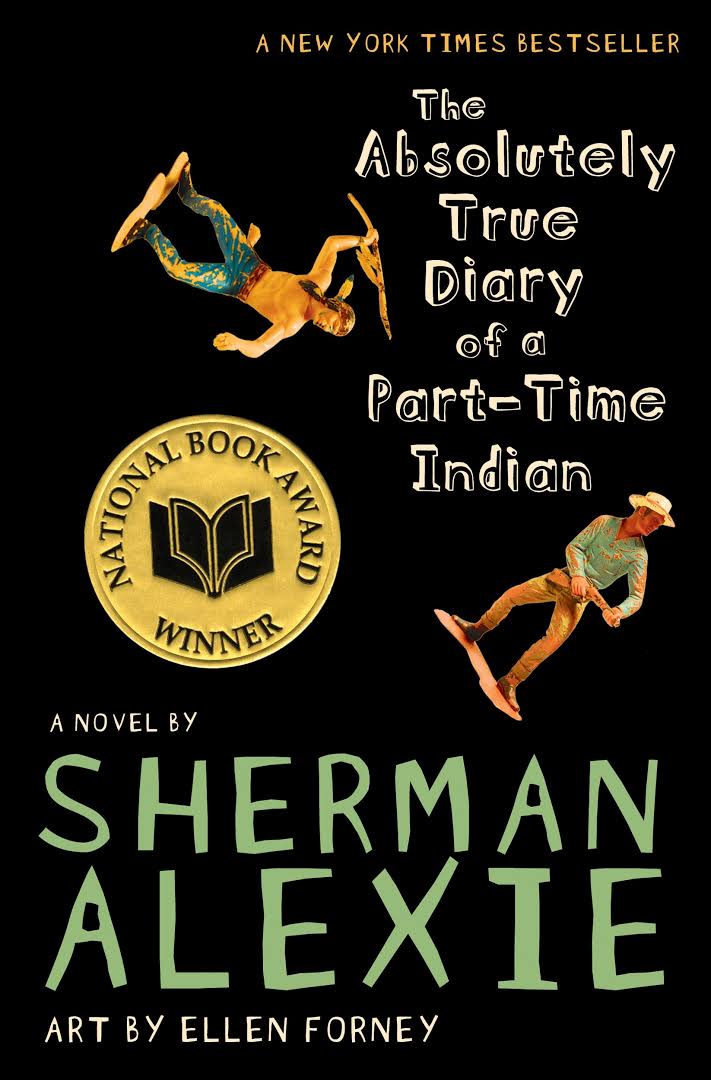
Title- The Absolutely True Diary of a Part-Time Indian


Author- Sherman Alexie

Illustrator- Ellen Forney

Publisher- Little, Brown and Company

Copyright Date- 2007

Number of Pages- 229

Awards- National Book Award for Young People's Literature (2007), American Indian Library Association Best Young Adult Book (2008), Boston Globe-Horn Book Award (2008), Odyssey 
Award (2009), California Young Reader Medal (2010)

Reading Level- age 13-17

Genre- Young adult fiction, realistic fiction 


Summary

Arnold Spirit Jr., aka Junior, the main character narrates his life from the Spokane Indian Reservation.  He takes the reader on a journey inside the life of a full blooded Indian, that feels half Indian half white.  The story starts with the difficult life he has led so far. He has an alcoholic father, a depressed mother, a best friend who is a jerk, and he was born with excess fluid in his brain causing a variety of medial issues.  After he throws a book at his teacher and gets suspended from school, his life takes a turn.  He decides he wants to travel 20 miles every day to the all-white school in a neighboring town.  Junior is torn between maintaining a loyalty to the reservation that has abused him his entire life, and bettering himself and attending the all-white school.  With his parents support he enrolls in the all-white school and is surprised at how differently he is treated, in a good way.  He joins the basketball team and becomes a key player.  He makes friends with the white kids, as he grows away from his best friend on the reservation.  After he leaves, his sister marries a Montana Indian and moves away.  You will have to read the book to find out what happens in Junior’s basketball season, with his sister’s marriage, his girlfriend, and with his best friend who hates him.

The story follows him through deaths, alcoholism, basketballs games, girlfriends, best friends, poverty, bullying, and many other teen issues.  He loves to draw cartoons, and the cartoons in the book often show more emotion than his words express.  They let the reader deep inside Junior’s thoughts and feelings.  It is humorous and sad.   The book is real, controversial, and even offensive at times.  

Teaching Ideas

This book would work in a mature classroom, it addresses many controversial issues including sex, drugs, bullying, alcoholism, and death.  There are racial and homosexual slurs.  The characters use profanity, and are often times very offensive.  With that being said, the issues that are addressed are real, they exist and are often times worse on reservations.   This book will give students a look into a different life, the life Native Americans on a reservation. 

The book could be used in a history class during the study of Native Americans.  The students could read the book and then study a tribe or research a reservation.  To connect back to the book, they could create their own comic that tells the story of the tribe they have researched.  This book actually mentions a reservation here in Montana, and this would give students here an immediate connection to the book. 

The book ends with a list of discussion questions, lessons could easily be created around these questions. 

The following are links to lessons already created for this book.


Ratings


Element of Literature

Excellent
Average
Inadequate
Not Addressed


Rating
Plot
The plot is engaging; the reader is invested in the outcome.  Contains conflict, a climax and a resolution.    The reader buys into the story line; it is believable to the reader. 
The plot is average it contains some of the essential elements such as conflict, climax and resolution.  One element is either missing or poorly developed.  The reader may or may not buy into the storyline, it is just not that believable. 
Multiple essential elements, conflict, climax and/or resolution are missing or poorly developed.  It is not believable and overall a bad plot. 

This plot is very engaging, and by the end of the story I needed to know what happened to Junior and his family.  I laughed and I cried as I read the book.  The plot is believable, everything that happens to Junior could happen to any teenage boy.  The plot contains conflicts, an emotional climax and ends with a friendly resolution.
Characters
Characters are unique and believable.  The characters come to life when the reader is engaged in the story.  When the book is done, the reader still connects with the characters of the book.  Characters have personalities, flaws, and feelings. There is a protagonist, possibly an antagonist and some supporting characters. 
Characters are similar to other books, have little to no uniqueness.  When the reader is done with the book, they are also done with the characters, there is no lasting connection.  Characters display little in terms of personality.  There are no supporting characters, or no clear protagonist.
Characters are dull and lifeless, there is no connection to the characters.  There is no clear protagonist and no supporting characters.  The characters are too farfetched.

I still have a connection to the main character, Junior., and I want to know what happened to him after his freshman year of high school.  All of the characters in this book reminded me of real people, they have flaws and display raw emotions.  The protagonist is Junior and the antagonist is his best friend.  The cast of supporting characters is big, and well developed.
Illustrations
The illustrations share in the story telling. The pictures help to develop the characters, establish the mood, and setting.  They contain some of the following elements, hidden details, facial expressions, different viewpoints, interesting asides, action depiction, or supporting details.  The pictures themselves may be created out of different mediums in order to support the plot.  Visual elements are used effectively (line, shape, color, texture and composition).
The illustrations support the story telling.  The pictures help with some but not all of the following, establish mood and setting, and developing characters.  They contain few if any of the following elements, hidden details, facial expressions, different viewpoints, interesting asides, action depiction, or supporting details.  The pictures are basic and do not use visual elements effectively.
The illustrations are in conflict with the story.  The pictures do not develop or establish anything in relation to the book.  There are no additional elements in the illustrations.  Visual elements detract from the plot.

The illustrations are essential to this book.  Junior writes and illustrates comics, these comics contain hidden details into his emotions and show details that just cannot be shown through the words of the story.  Without the illustrations this book would not be the same, they are part of the story. 
Word Choice
There are a more than two of the following elements used effectively, precise vocabulary, figurative language, dialogue, and music in language. 
There are one or two of the following elements used effectively, precise vocabulary, figurative language, dialogue, and music in language. 
There are none of the following elements or they are not used effectively, precise vocabulary, figurative language, dialogue, and music in language. 

The word choice is average.  The book is written from the perspective of a 14-year-old boy, so I would say that precise vocabulary is used. There is some dialogue.   However, there is little figurative language, and no music in the language.